
Visiting Middlesex University Lab

General info: We are currently recruiting infants aged 4-9 months for a study looking at how babies perceive musical sounds. The visit takes approx 30 – 45 minutes and, as part of the study’s procedure, children will be watching videos depicting abstract shapes paired with short musical sounds. While watching the videos on a computer screen, childrens’ gaze will be recorded using a non-invasive technique called eye-tracking. Eye-tracking allows us to identify where visual attention is focussed on the screen (more details on the page below). You will be with your child throughout your visit.
Location: Middlesex University (Hendon) Babylab in the Hatchcroft Building, Hendon, The Burroughs, NW4 4BT. Only one visit to the lab will be required.
As a souvenir, we will take a picture of your child as a Middlesex University Junior Visiting Scientist!
For more information, please contact Tatiana Sobolewska, a Ph.D. researcher who is running the study, on t.g.sobolewska@mdx.ac.uk.

Research on infant development can only continue with the help of parents
We hope to hear from you soon!
Address
Middlesex University (Hendon)
The Burroughs
London
NW4 4BT
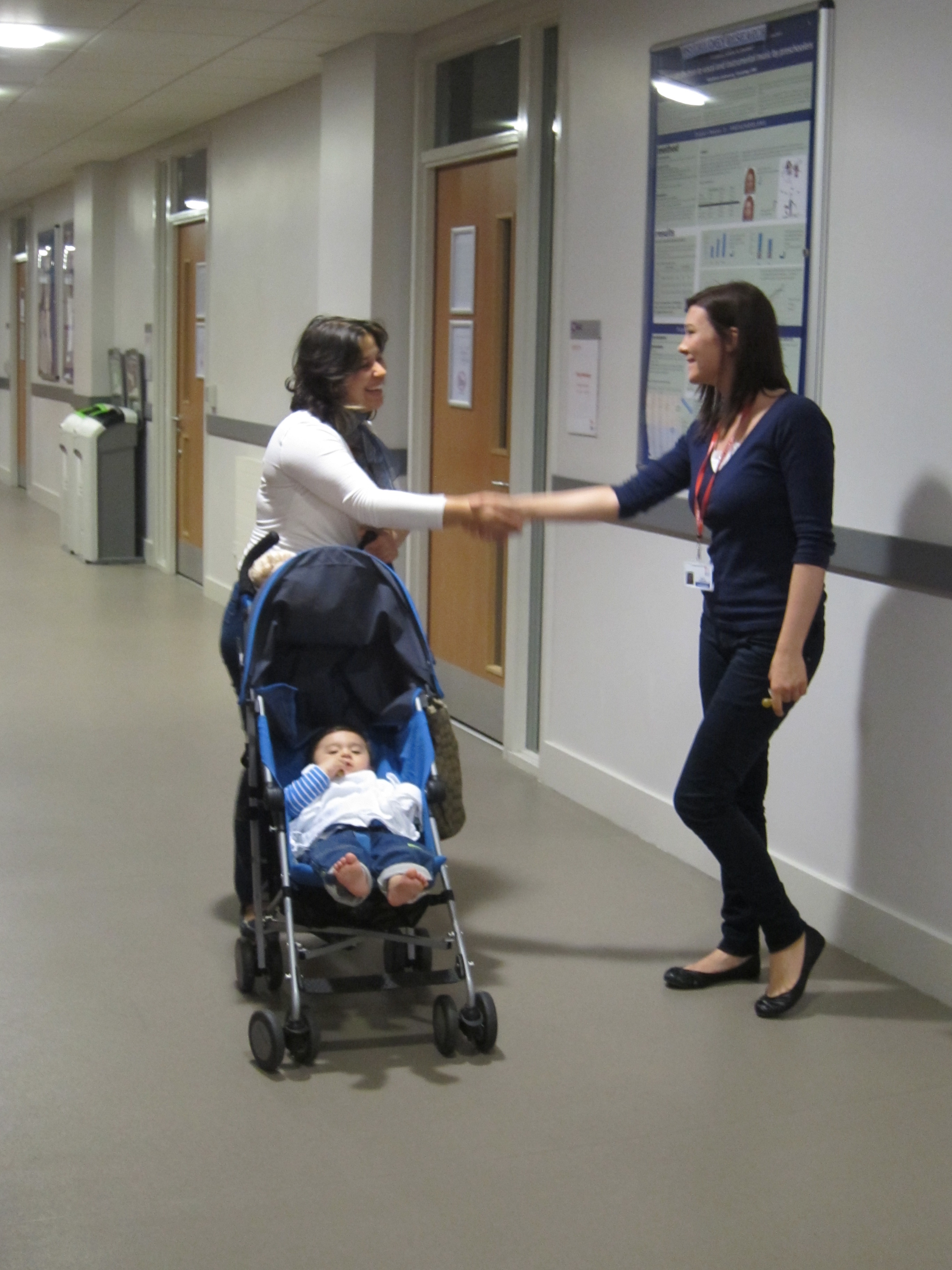
What happens during a visit to Middlesex babylab with your baby?
A typical visit to our lab will involve:
- Welcoming you and your child in a friendly and relaxed atmosphere, followed by some playtime.
- We will talk about the study and answer any questions you may have.
- We will ask you to sign a consent form and complete some questionnaires, typically, about musical experiences in the family, and demographic information.
- Once everyone is ready, we will then take you and your child to a quiet room with a child-friendly seat, where we will play short videos on a computer screen and speakers. The researcher will be able to see the baby via a camera and will monitor the progress.
- During a visit to the lab, you will always be with your child and we take the utmost care to ensure that your visit is as enjoyable as possible.
This is a Little Scientist in Residence at Middlesex BabyLab taking part in an eye-tracking study: When someone is speaking, we can see that baby is looking at the eyes. The eye-region is very informative about feelings and emotions, and is also very important to tell what the speaker is paying attention to. We use eye-tracking in a variety of studies, often in cross-modal matching tasks. Eye-tracking is a non-invasive technology that helps us to understand what children are paying attention to and what they like!

COVID STATEMENT
Following the re-opening of our lab, we conform to all COVID-related precautions and all visitors’ safety is our priority. All equipment is regularly cleaned and sanitised between visits. Face masks are always worn by staff working in the lab. Face masks and sanitisers will be available to use on the day of your visit. Please let us know, if there are any special precautiouns that you would like us to take into account when welcoming you in our lab.
Junior Visiting Scientists in residence at babyLab!



How to find us
Our BabyLab is located in the Hatchcroft Building that can be accessed via the gate on the left-hand side of the main entrance to Middlesex University (off The Burroughs). Upon arrival, I will meet you by the entrance to the Hatchcroft Building (if driving, I can meet in the car park). Please let me know once you arrive by the Hatchcroft Building by ringing 07983352217.

Parking
Visitor’s parking is located behind the Ravensfield Theatre car park, which is on the opposite side to the Hatchcroft building. The exact location of the parking in respect to the Hatchcroft building can be seen on the attached map. Upon arrival by the car park’s entrance, please press the intercom (marked on the attached map by a gold square) and state you’re a visitor and provide your name.

An interactive campus map can be found here: Middlesex University Hendon Campus
Contact
PhD Research Student
Tatiana Sobolewska
t.g.sobolewska@mdx.ac.uk
 A Middlesex University Research Group